

Oyster Restoration in Virginia
Aggressive oyster reef restoration efforts are bringing a vital natural and economic resource back to Virginia waters.
Bringing back an icon to the Chesapeake Bay


Oysters are one of the Chesapeake Bay’s most iconic and valuable species, providing cultural, economic, and environmental benefits that support the region’s way of life. For generations, oysters have been central to the heritage of Bay communities and local economies through commercial harvest and aquaculture and now the largest oyster reef restoration on the planet.
Oysters filter sediment and algae and remove nutrients that degrade water quality and habitat for fish and aquatic plants. Their reefs provide nurseries and feeding grounds for rockfish, crabs and other commercially and recreationally important species.
Overharvest and disease have decimated oyster populations over the last hundred years. While historic populations could filter the entire bay in days, current populations take close to a year. Increasing oysters and oyster reefs is critical to restore the health of the Chesapeake Bay and our local communities.
The Nature Conservancy and partners have been working for more than a decade to reverse the tide of oyster loss in the Chesapeake Bay. TNC supports a “three-pronged approach” for restoring oysters in the Bay:
Areas that allow oysters to grow, reproduce, and form a dense 3-D reef habitat for fisheries and other aquatic species.
Managed areas that support commercial and recreational harvest.
Managed oyster farming that produces sustainable seafood while providing environmental benefits such as improved water quality, habitat creation, and support for oyster population recovery.
The world's largest oyster restoration initiative successfully completed

For more than a decade, The Nature Conservancy collaborated with state and federal agencies, academic institutions, industry partners and nonprofit organizations to restore oyster reefs in 11 bay tributaries across Maryland and Virginia. This is the largest oyster restoration initiative in the world, and early signs indicate that the reefs are self-sustaining and helping grow oyster populations across the entire Bay. This unprecedented partnership exceeded the Chesapeake Bay Program’s 2025 goal, restoring more than 1,900 acres of reef habitat and planting over 7 billion oysters. Restored reefs improve water quality, provide critical habitat for other aquatic species, support commercial and recreational fisheries, and strengthen the resilience of coastal communities. Long-term monitoring efforts are showing that many of these restored reefs are meeting or surpassing restoration targets. There is evidence of strong natural reproduction and that these restored reefs are becoming self-sustaining ecosystems that help rebuild oyster populations beyond restoration sites.
Yet this milestone is only one step in a much longer recovery journey. Despite the success of this initiative, native oyster populations in the Chesapeake Bay remain a small fraction of their historic size. The Bay is still far from full ecological recovery, but achieving the Bay Program's 2025 oyster restoration goal proved that large-scale oyster restoration works and delivers real ecological and economic benefits. It stands as a global model for effective federal-state partnership and nature-based solutions.
Partners across the Bay remain committed to building on this progress through the next Chesapeake Bay Watershed Agreement, including ambitious goals to restore an additional 2,000 acres of oyster reef habitat by 2040. With sustained commitment, oyster restoration can move towards long-term recovery, ensuring cleaner water, stronger coastal economies, and a more resilient Chesapeake Bay for future generations.
The restoration of oyster reefs proves that large-scale recovery is possible and offers a roadmap for the Chesapeake Bay's future.
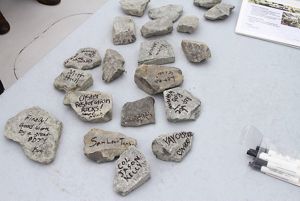


Oyster Restoration Rocks!: Piankatank River Oyster Recovery Project partners signed pieces of granite as part of a 2017 dedication ceremony for a newly constructed 25-acre oyster reef. © Patrick Bloodgood / U.S. Army photo
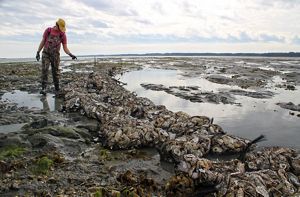
Building a Reef: Granite rock is methodically placed in Virginia's Piankatank River to form the newest, 25-acre oyster reef in the Chesapeake Bay watershed. © Patrick Bloodgood/U.S. Army photo
Future Resilience: TNC's Brittany Gonzales counts bags of shell placed by Dickinson College students at the Hillcrest Oyster Sanctuary during an alternative spring break experience, March 2020. © Daniel White/TNC
Making New Substrate: Teachers try their hands at creating new oyster reef substrate. The substrate will be used in a NFWF funded marsh protection project near the village of Wachapreague. Aug 2020 © Margaret Van Clief / TNC
Supporting Oyster Aquaculture and Restoration


Since 2020, TNC has been leading a unique partnership between oyster aquaculture growers, state agencies, and other non-profit partners to purchase 1.5 million surplus oysters from Chesapeake oyster farms to be used to help build and expand local oyster sanctuaries.
When COVID-19 shuttered restaurants in 2020, Chesapeake Bay oyster growers found themselves faced with a grim reality: no place to market their shellfish, which were beginning to grow too large for raw bars. Suddenly their industry—in which it can take up to three years to grow an oyster to the ideal size to sell to restaurants—was in dire straits. TNC worked with private donors and other partners to purchase 1.5 million oysters from these Chesapeake Growers, which were then added to several large-scale oyster sanctuaries where they will continue to provide water quality and habitat benefits.
“The value of SOAR extends beyond this project. It will serve to create partnerships that will result in new market opportunities and enhanced conservation efforts in the years to come.”
Karl Roscher, Assistant Director, Fishing and Boating Services, MD DNR
Oyster aquaculture in the United States has many benefits: providing jobs in coastal communities; creating a sustainable source of seafood; improving water quality and the health of our oceans and estuaries; and providing habitat and nurseries for fish, crabs, and other species. The Nature Conservancy supports oyster aquaculture as a sustainable industry to produce a healthy food source, supports local economies, and provide environmental benefits.
The Bay’s oyster aquaculture industry—one of the largest on the East Coast—can contribute to conservation, while providing sustainable seafood and green jobs.
Learn more about our work with oysters

