


On warm summer nights at Surry Mountain Preserve, small devices strapped to trees record sounds that most of us never hear. Those recordings became the focus of a recent research project led by three students from Southern New Hampshire University.
Liberty Furr, Audrey Brecheen and Michael Bates worked with The Nature Conservancy to survey bat activity at the preserve as part of their academic work. With guidance from faculty advisor Dr. Katharine York, the students set out to better understand which bat species are using the forest and how bats respond to different habitat conditions.

Call of a Big Brown Bat
Students from Southern New Hampshire University used specialized software to visualize bat calls recorded at Surry Mountain Preserve.
This audio contains the sound of a big brown bat's call only.
The scale of the work was impressive. Using acoustic detectors, the team utilized special software called SonoBat to listen to and process more than 32,000 bat calls, carefully reviewing and organizing the data over several months. Their analysis confirmed the presence of multiple species at Surry Mountain, including little brown bats, big brown bats, hoary bats, and northern long-eared bats, a federally endangered species.

The students completed a detailed analysis of these recordings and helped turn raw data into valuable information that can be applied directly to stewardship at the preserve. By looking closely at how bats are using different parts of the forest, the students added an important layer of understanding to ongoing conservation work at Surry Mountain.
“This analysis gives us a clearer picture of how wildlife is responding to the forest as it changes,” says Stewardship Coordinator Myrilla Hartkopf. “Having this level of detail will be incredibly helpful as we continue managing Surry Mountain for climate resilience and work to support the full range of species that call this forest home.”
This analysis gives us a clearer picture of how wildlife is responding to the forest as it changes. Having this level of detail will be incredibly helpful as we continue managing Surry Mountain for climate resilience and work to support the full range of species that call this forest home.

For the students, the project provided hands-on experience with real conservation challenges. For TNC, it brought new perspective and valuable insight into an evolving approach to forest management.
Most visitors to Surry Mountain Preserve will never hear a bat call. Yet hidden in those high-frequency sounds are clues about the health of the forest and the wildlife that depends on it. By listening closely, we're gaining a deeper understanding of this landscape and the species that call it home.
Signals in the Dark
Analysis of more than 32,000 bat calls revealed that at least eight different bat species can be found at Surry Mountain Preserve. This includes species at risk like the Northern long-eared bat, small-footed bat, tricolored bat, and little brown bat.
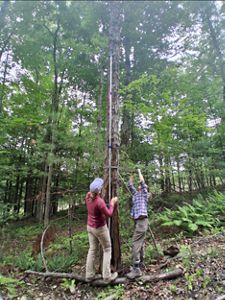


Listening for Bats: TNC's Myrilla Hartkopf and Joanne Glode set up an acoustic monitoring station at Surrry Mountain Preserve in southwestern New Hampshire. © Katie Folts/TNC
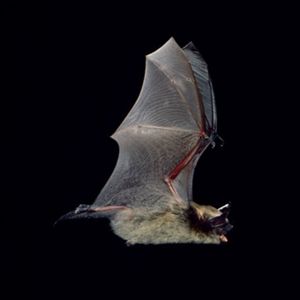
Little Brown Bat: To be ready for their insect catching feats each night, little brown bats need a lot of rest, sleeping for around 20 hours per day. © MerlinTuttle.org
Moon Over the Mountain: The moon rises over Surry Mountain in southwestern New Hampshire. © Joe Klementovich
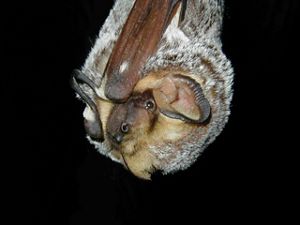
Hoary bat: Close up of hoary bat face while it hangs upside down. © Paul Cryan/USGS, Flickr, CC by 2.0
Big Brown Bat Call: Students from Southern New Hampshire University used specialized software to visualize bat calls recorded at Surry Mountain Preserve. © SNHU/TNC
Explore More of Our Work

What Does It Mean to Steward Land and Manage for Resiliency?
Successful conservation requires science-based management and stewardship. Learn how we’re ensuring a healthy future for New Hampshire's lands.

How Conservation Grows in New Hampshire
Explore how early efforts in land protection, prescribed fire and oyster restoration helped shape conservation in New Hampshire, and how today's innovative work could shape the future.

Surry Mountain Preserve
Towering trees. Safe haven for wildlife. Free-flowing streams. Abundant recreational possibilities. Surry Mountain Preserve is a place rich with natural treasures.