
interstitialRedirectModalTitle

interstitialRedirectModalMessage

Stories in New York

Building Safer Roads in a Region on the Move

New approaches across the Appalachians aim to reduce wildlife crashes and rebuild the pathways nature needs.

A wide illustrated landscape featuring mountains, rivers, roads, animals and vibrant flowers, highlighting habitat connectivity.
Connected Appalachian Habitats Thoughtful design allows roads to support safe movement of wildlife and people across the landscape. © Liz Burdick Arts

Roads help people move. But they often do the opposite for animals. The Nature Conservancy developed the Northeast Habitats and Highways initiative together with transportation planners to expand proven solutions that help wildlife and people travel more safely.

On a highway at dawn, commuters trace familiar routes through wetlands, forests and farmland in the shadows of the Appalachians. Below them, along a dirt path under a bridge, fresh hoofprints—moose or deer—mark the safer, quieter route wildlife take when the landscape allows.

This is the daily choreography of one of the most densely populated regions of the United States: People move, wildlife move and their routes intersect. Layered onto this constant motion is another force reshaping the region: the Appalachians are now an epicenter for extreme rainfall, with long, intense storms increasing year over year.

An illustration of two people in safety gear standing beside a road, examining a large culvert as blue floodwaters flow beneath it, with rain falling across a valley of homes, rivers and bridges.
Designing for Future Floods Transportation staff assess culverts to plan nature‑based road design that helps manage flooding and protect communities. © Liz Burdick Arts

Why It Matters

Roads aren’t just passages for people; their design affects the health of nature, the safety of communities and the resilience of the places we live. When infrastructure doesn’t account for nature, it can slice through habitats that keep ecosystems thriving, leading to more wildlife-vehicle collisions and increased flooding.

“Busy roads make it treacherous for wildlife to move and migrate,” says Alissa Fadden, who manages wildlife connectivity projects for TNC. “Climate change is hitting in two ways: heavier rainfall is straining roads and culverts, and warming temperatures are driving shifts in ranges, causing wildlife to move further and faster to find habitat.”

So, we must move further and faster, too.

If wildlife can’t move, we’re all affected

Climate change is driving animals to move north an average of 11 miles and approximately 36 feet higher in elevation each decade.

When wildlife can’t move freely, we all feel the impact: 

  • An average of 200 people die and 26,000 are injured in the U.S. each year in wildlife-vehicle collisions.
  • Vehicle accidents involving wildlife cost approximately $10 billion in the U.S. annually.
  • Swerving to avoid wildlife and collisions can be traumatic to drivers and passengers and snarl traffic.

Watch: Infrastructure with Nature in Mind.

Northeast Habitats & Highways (2:45) How can we make roads safer for people and wildlife? The Northeast Habitats and Highways project highlights success stories from TNC and key partners that dive into this critical question. © Peregrine Productions

What If Better Road Design Could Keep Everyone Safer?

For decades, TNC has built relationships and learned from local and state transportation and natural resource agencies across the Appalachians. This regional vantage point and our global perspective allow us to identify solutions that work and scale tools that can speed up progress across the thousands of miles of roads in the region.

Appalachian Road Network Map A regional map highlights the Appalachians, major roads, and connected habitat networks that guide planning for safer wildlife movement. © TNC

The Northeast Habitats and Highways video series, launched in 2025, aims to spark a cultural change that helps transportation and conservation professionals collaborate early, build infrastructure with nature in mind and reduce wildlife-vehicle conflicts.

Turning Local Success Into Regional Change

Northeast Habitats and Highways was created with and for transportation professionals, municipal planners and other agency staff. The videos highlight success stories, provide practical tools and elevate real-world examples that show how wildlife-friendly design can become standard practice.

From critter shelves to right-sized culverts (structures that let water pass under a road), the series spotlights projects led by partners across eight Appalachian states: Maine, New Hampshire, Vermont, Massachusetts, Connecticut, New York, Pennsylvania and New Jersey.

The series was modeled after a nationally recognized training developed by the Vermont Agency of Transportation and Vermont Fish and Wildlife Department.

“People took the training early in their career and carried what they learned about ecology into management roles, affecting how projects were planned and reviewed,” says Jens Hawkins-Hilke, a conservation planning biologist with the Vermont Fish and Wildlife Department.

“Nothing has been more successful at changing the culture within our transportation agency.”

Three people in safety vests stand in dense wetland vegetation holding sampling equipment and gear.
Surveying Wetland Habitat Field staff document wetland and stream conditions near a roadway to help improve culvert design, allowing water and wildlife to move safely beneath a roadway. © Peregrine Productions

Building a Network That Can Extend Impact

Stay Updated

Want to be the first to know more about the projects happening in your area?

Please provide a valid email address

You’ve already signed up with this email address. To review your email preferences, please visit nature.org/emailpreferences You’ve already signed up with this email address. To review your email preferences, please visit nature.org/emailpreferences

We may have detected a typo. Please enter a valid email address (formatted as name@company.com). Did you mean to type ?

We are sorry, but there was a problem processing the reCAPTCHA response. Please contact us at webmaster@tnc.org or try again later.

From low-cost retrofits for small animals, to road designs that support larger wildlife movement, to policy changes that shape how entire agencies operate, Northeast Habitats and Highways aims to drive solutions at the full range of scales that wildlife travel—from a few feet to entire landscapes.

To help the series reach the people who can champion and apply these innovations, the team tapped into the Staying Connected Initiative, a network of government agencies, universities, land trusts and nonprofits in the Northeast established by TNC to keep forests connected and ensure that infrastructure supports wildlife movement.

In New York, the training series has already been approved for continuing education credits—an early signal that the resource resonates with planners and engineers.

What Scaling Looks Like—State by State
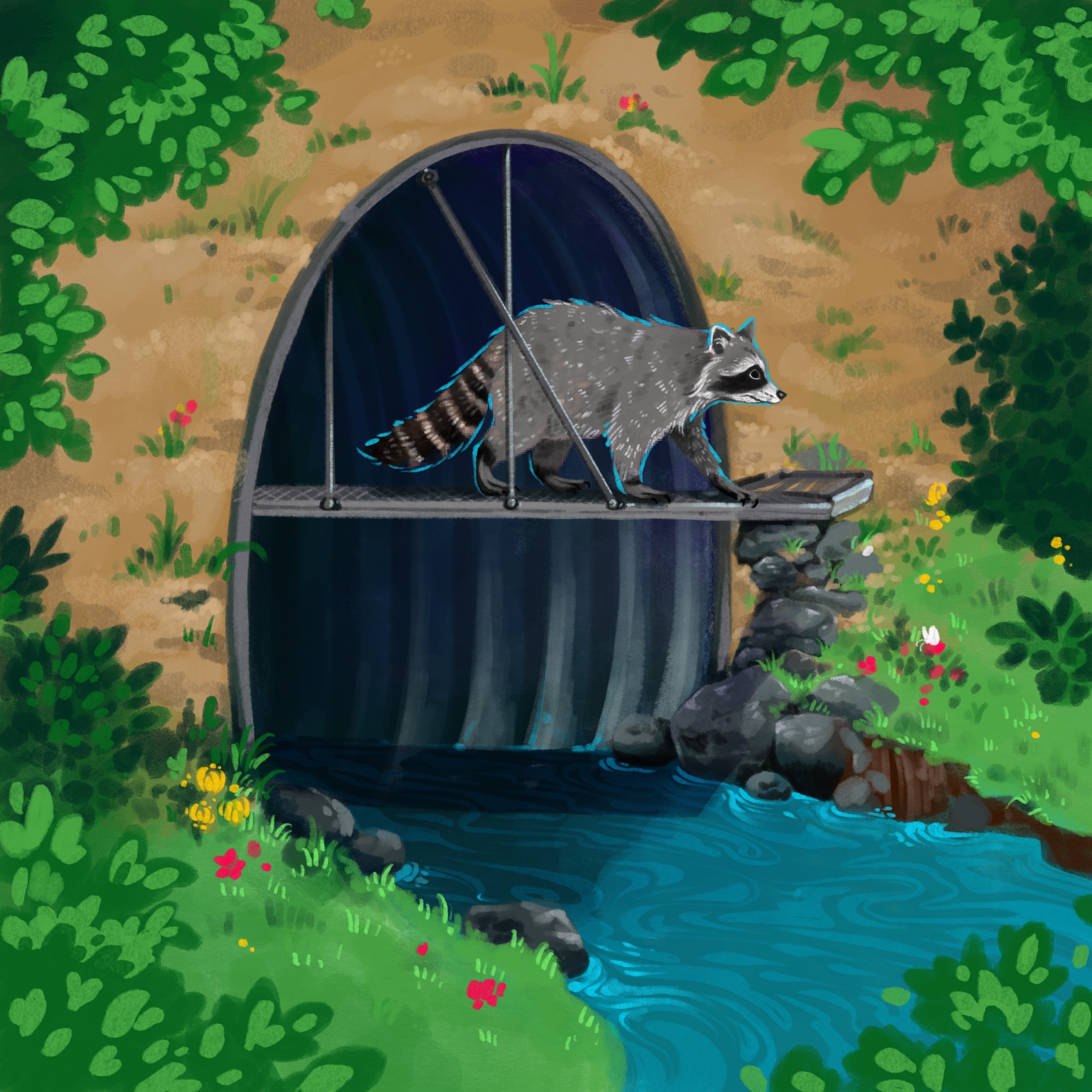
An illustration features a raccoon walking along a metal wildlife shelf inside a rounded culvert above a flowing blue stream, surrounded by lush greenery.
Raccoon on Wildlife Shelf A raised shelf inside a culvert shows how simple retrofits can give small animals a safe path under roads. © Liz Burdick Arts

New York

A Corridor Just for Critters

Under a busy road in northern New York, TNC and the New York State Department of Transportation installed a simple, inexpensive fix: a steel mesh “critter shelf” in a culvert to give mink, groundhogs, raccoons, weasels and other small animals their own corridor so they can travel and move while avoiding cars.

Developed in Montana and adapted for New York, the shelf demonstrates how good ideas can travel. Stephanie Delano, director of the Environmental Science Bureau at the New York State Department of Transportation, says, “We learned about the work in the West, worked with The Nature Conservancy to adapt the design and build a shelf here, and we’re proud this project is featured in the Habitats and Highways series, reaching our peers who can replicate similar solutions in their states.”

Boonville, New York: NY State Route 12 (1:21) Near Boonville, New York, TNC and NYDOT installed its first “critter shelf” inside a large Route 12 culvert—creating a dry walkway that lets bobcats and other wildlife move safely under the road instead of crossing traffic. © Peregrine Productions
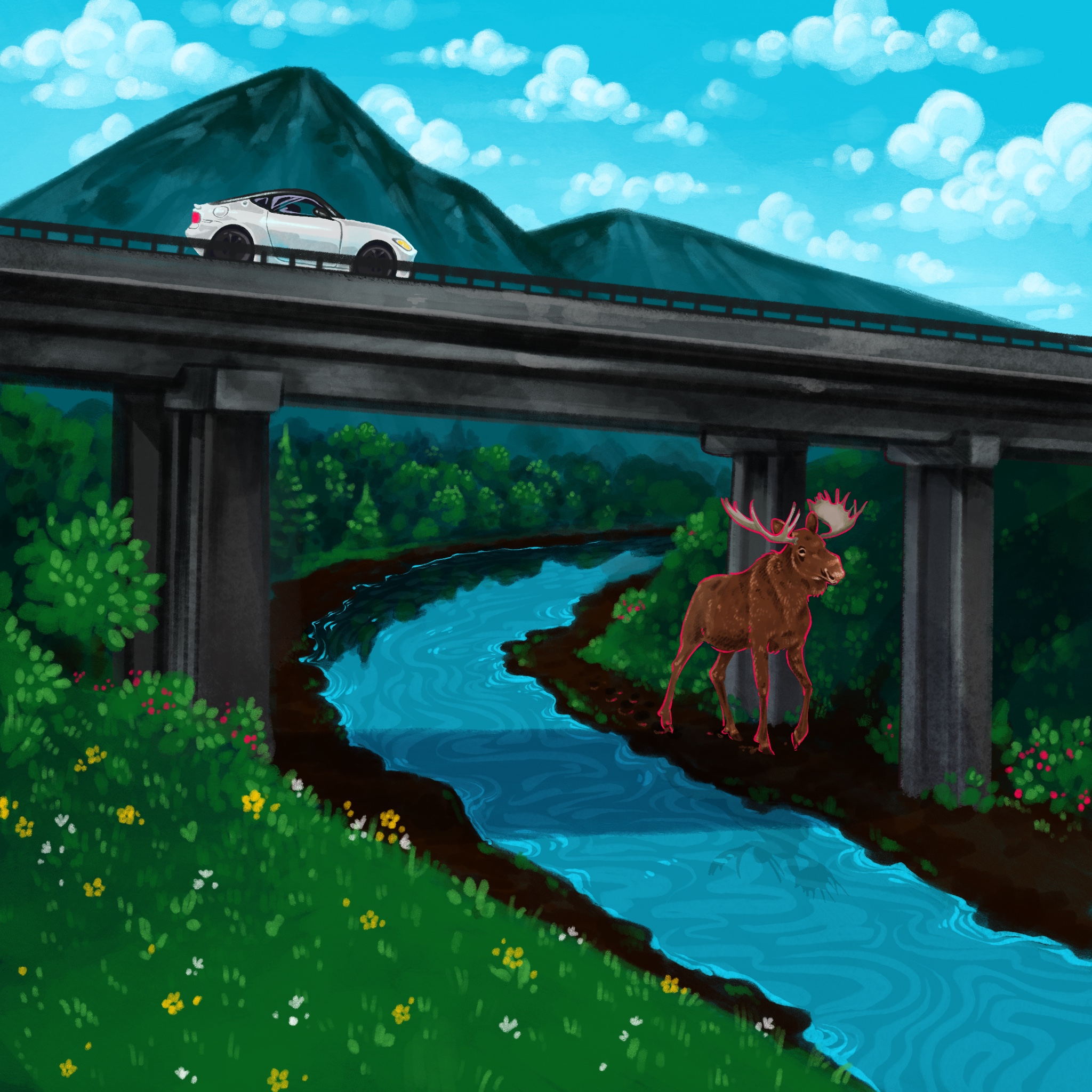
A colorful illustration of a moose standing beside a winding blue river under a tall highway bridge, with a white car traveling along the bridge and mountains in the background.
Moose Beneath Road Bridge Elevated roadways allow large mammals like moose to move safely along rivers and under bridges. © Liz Burdick Arts

Vermont and New Jersey

From One Bridge to Every Bridge

A small investment—$10,000 within an $8 million project—helped Vermont’s Fish and Wildlife Department and Agency of Transportation build the state’s first wildlife shelf under a bridge along the Little River. “This dirt path allows moose, deer and other animals to move under the bridge instead of on the road,” says Hawkins-Hilke. “It was so successful that it is now our standard procedure to put similar structures under any bridge project with enough room for a corridor.”

Vermont isn’t the only state establishing transportation policies to help wildlife: New Jersey passed the Wildlife Corridor Bill, which appropriates funding to assess how proposed roads impact wildlife, including endangered bobcats. It also directs agencies to collaboratively identify key corridors and collision hot spots, prioritize crossing projects and improve safety for both motorists and wildlife.


Waterbury, VT: Little River Shelf, I-89 Northeast (1:17) In Waterbury, Vermont, a wildlife shelf built along the Little River under I‑89 now offers animals a dry, safe path beneath six lanes of traffic—reconnecting key forest habitats and reducing collisions. © Peregrine Productions
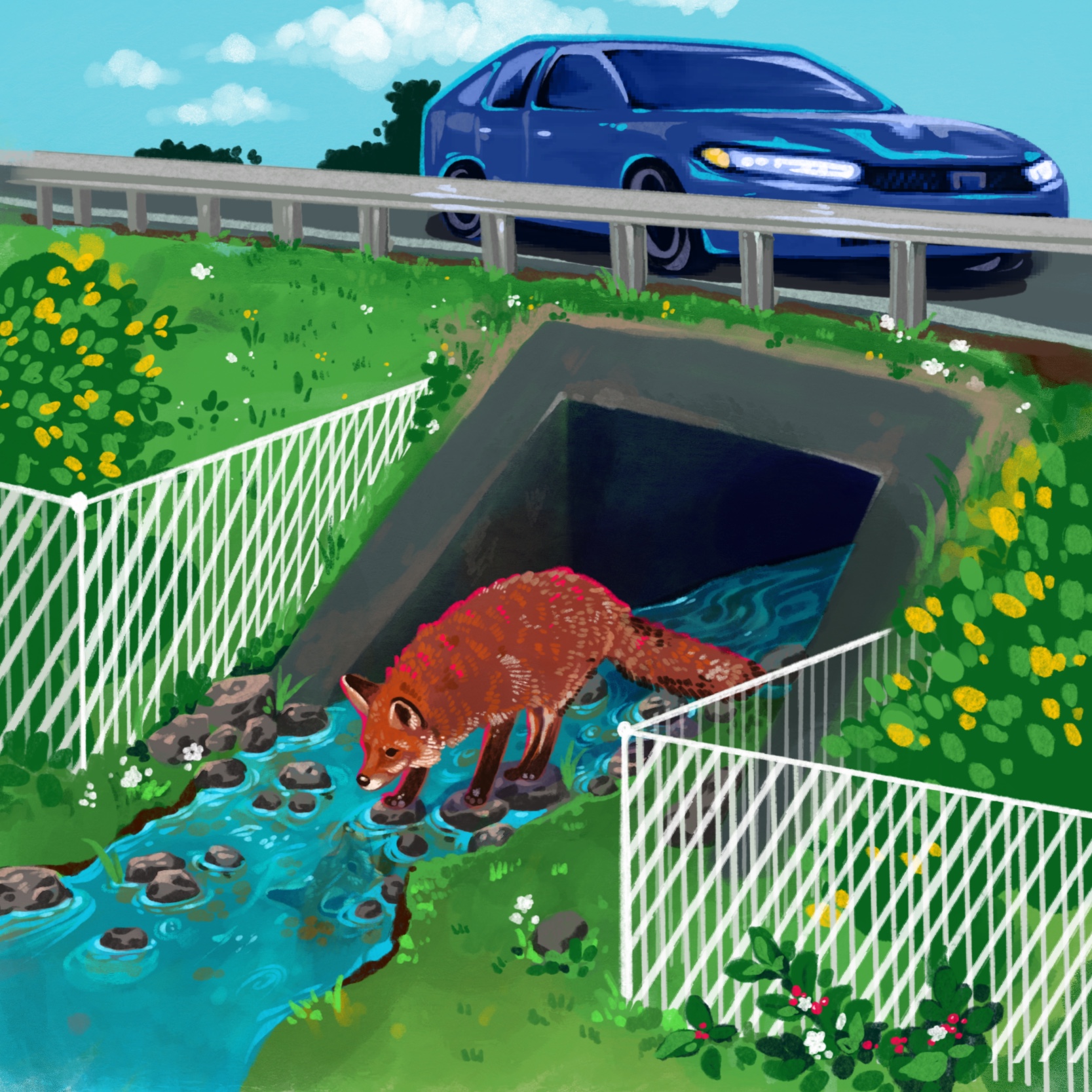
A colorful illustration of a fox walking through a shallow stream inside a culvert while a car drives overhead and fencing directs wildlife movement.
Safe Crossing for Wildlife Culverts and fences guide animals like foxes toward safe under-road pathways that keep them away from traffic. © Liz Burdick Arts

Maine and Connecticut

New Roads for People, New Features for Wildlife

When planners at the Maine Department of Transportation designed six miles of new road, they treated it as a chance to reduce collisions, mitigate flooding and keep habitat connected. Wildlife fencing now guides animals away from traffic and toward culverts that carry water during storms and give fish and aquatic animals an easy way through.

In Connecticut, planning for a new road in Brookfield, led by the Connecticut Department of Transportation (CDOT), began with wildlife assessments. As the project was designed, CTDOT added concrete barriers that usher wildlife toward a tunnel under the road. Cameras showed deer, skunks and other mammals using it immediately, and radio-tracked turtles soon followed.

Brewer to Eddington, ME: I-395/Route 9 Connector (1:17) In Maine, the 6‑mile I‑395/Route 9 Connector includes two dedicated wildlife crossings with fencing that guides animals safely under the road—helping reduce collisions while improving regional travel. © Peregrine Productions
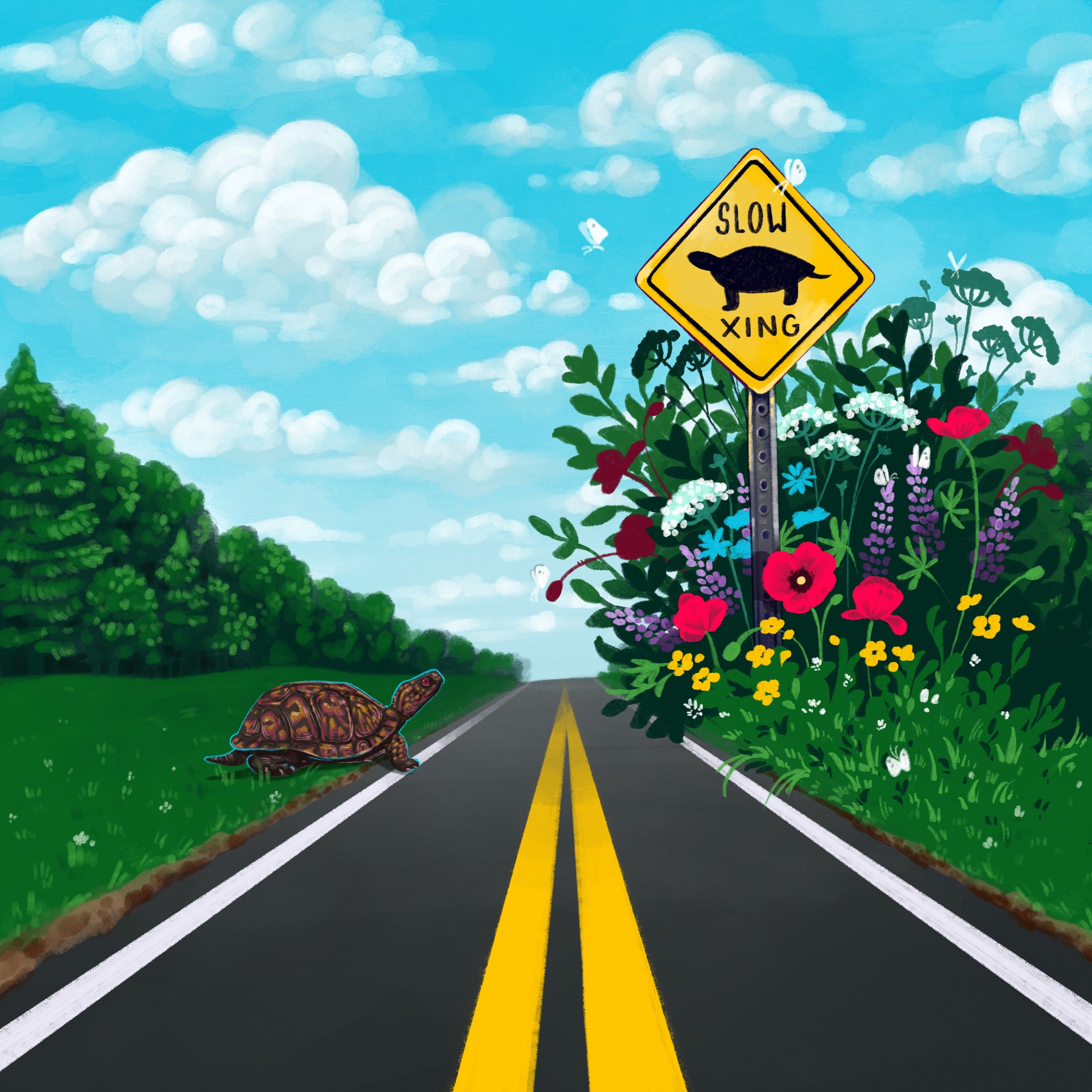
A colorful illustration of a turtle approaching a paved road with a yellow turtle‑crossing sign beside a patch of bright wildflowers and green shrubs.
Turtle Crossing Awareness Road signs and planted roadsides help alert drivers to slow down and protect wildlife like turtles crossing busy routes. © Liz Burdick Arts

New Hampshire and Massachusetts

Making Room for Migrating Wetlands

In New Hampshire, modeling showed TNC scientists that a protected section of coastal marsh critical for birds, including the vulnerable saltmarsh sparrow, would be overtaken by sea-level rise in the coming decades. Storm flooding was also making an upland road unsafe for drivers. Together, TNC and the local public works department replaced an undersized culvert that blocked migratory fish and contributed to flooding. The new design also creates room for the marsh to move inland as sea levels rise, allowing the habitat itself to migrate rather than drown.

Now, more water moves under the road during extreme rain, the marsh can shift naturally, and wildlife from fish and eels to deer, otters and bobcats use the crossing and stay clear of traffic.

Across the region, agencies are confronting similar challenges. In Massachusetts, the state’s transportation and fish and wildlife agencies redesigned a site planned for mixed development and a new parkway to better support wildlife movement. The project added three wildlife crossings and a stream crossing to keep species connected, with fencing and wing walls guiding animals safely toward those crossings.

Newmarket, NH: Bay Road (1:36) In Newmarket, the Bay Road culvert was replaced to restore tidal flow and reopen safe passage for eels, fish, and other wildlife—transforming a long‑standing barrier into a resilient crossing that benefits both nature and the community. © Peregrine Productions

The Details That Add Up

You don’t need a megaproject to make a difference. In addition to building roads, retrofitting bridges and replacing undersized culverts, transportation agencies and municipalities are also embracing smaller, creative and repeatable actions that scale fast:

  • New Jersey: Small tunnels and signs are getting the attention of drivers and helping rare turtles cross safely.
  • Seneca Nation: Adding large, flat stones to a riverbed during a bridge replacement project is creating shelter for the rare hellbender salamander.
  • Massachusetts: Seeding roadsides with native flowers is supporting monarch butterflies.
  • New York: Adjusting mowing schedules for right-of-way areas along roads and planting pollinator gardens at highway rest areas supports migrating birds and insects.
  • Pennsylvania: Planting tall trees along roadways encourages bats to fly above the level of traffic and using sand in crossings helps track prints to learn which animals are using passageways.
Centre County, PA: U.S. 220 Highway Improvement (1:13) In Centre County, upgrades along U.S. 220 added wildlife underpasses that cut animal‑vehicle collisions from nine to one, helping reconnect habitat and keep drivers safer. © Peregrine Productions

Designing Roads That Let Nature Move

Each season brings its own movement in the Appalachians—birds migrating, fish moving between fresh and salt water, and mammals seeking food and shelter. TNC and partners across these eight Appalachian states are working with transportation agencies to build projects that respect the importance of those movements, reconnect habitat, reduce collisions and handle the extreme rainfall reshaping the region.

“The more we help nature move, the safer and stronger our communities become,” says Fadden. “These projects show that when planners, engineers and conservationists learn from one another, practical ideas can spread fast and make travel safer for wildlife and people alike.”

We need your help

With your ongoing support, we can apply science to prioritize where to help wildlife and provide training to the people who make decisions about land and water. Help us apply this proven approach across roads, across states, across seasons and across the Appalachians.

Learn More