


The Power of Fire: A Critical Resource for Resilient Lands
Fire fuels the health and productivity of many Pennsylvania and Delaware landscapes. Learn how TNC is returning this natural process to the landscape.

Long Pond Barrens Birding Discover the incredible variety of bird species and their unique habitats in the Poconos, made possible through TNC's conservation efforts. © Katherine Rosenberger
Welcome to the Long Pond Barrens Birding Trail!
Nestled in a unique mesic till barrens habitat, this trail offers a delightful blend of recreation and community science. On-site, you can follow the stations and scan QR codes with your mobile device to access our interactive audio tour. If you prefer a virtual experience, enjoy the tour by listening to each station clip below.
The Long Pond Barrens is a vibrant haven for diverse plant and animal life, thanks to The Nature Conservancy's dedicated stewardship and land management efforts. Our active land management efforts, including controlled burns, play a crucial role in restoring avian habitats and maintaining ecosystem health.
Follow these simple steps:
Download the Merlin Bird ID app to record and identify the birds you see along the trail. Download Merlin Bird ID
Download the eBird app to create a checklist of birds you see and hear along the trail. Upload your checklist to the “Long Pond Preserve – Long Pond Barrens” hotspot. This community science will help us to keep a running list of species found along this preserve. Download eBird
Follow the Birding Trail along the marked path. You will run into 10 stations, each with its own unique audio and information. You can visit the stations in any order. As you explore the trails, make a note about the birding station that you were closest to when you observed the bird. You do not have to visit every station to participate in logging your sightings. Log the birds you see and hear using our eBird Hotspot
Hear the black capped chickadee and explore the sights and sounds of station 1.
Listen for the call of the Black-capped Chickadee. You may see their black and white masks poking out of bird boxes or tree hollows. The black-capped chickadee prefers open woods, often nesting in the snags of birch trees and commonly found near forest edges.
This stark edge, separating the pipeline from the forest, is an ideal spot to notice the structural transition of the barrens. You can see where this open meadow gradually becomes a sparse canopy and as you walk through this firebreak, you will notice a slow transition to dense forests. TNC has mechanically mowed this area for trees smaller than 6 inches in diameter. This was in part, a pre- prescribed fire treatment to ensure TNC is meeting our objectives of creating canopy gaps and reaching an ideal structural composition that will benefit foraging, nesting, and hunting opportunities for birds and other wildlife. The mowing treatment provides a safe opportunity to reduce the accumulated fuels, by minimizing flame heights and the fire’s rate of spread during prescribed fire operations..
You will see that select tree species, like pitch pine, were intentionally left uncut as TNC is supporting a conifer rich forest type on this part of the barrens. Pinecones may be layering this forest floor, and the curious Chickadee may be prowling for their seeds to carry them through winter. If they see you coming, they may add more “dees” to their song to communicate you as a potential threat.
Hear the common yellowthroat and explore the sights and sounds of station 1.
Here at Long Pond, you’re standing in a rare mesic till barrens habitat. It’s teeming with fascinating plant and animal life. Notice the early successional species like goldenrod, sweet fern, and other acidic soil loving shrubs.
If you turn to face the parking lot, you’ll see various plant species competing for the mesic till barrens. This habitat is defined by its unique plant composition and acidic soil, rare to the region.
Keep an eye out for scrub oak, ericaceous shrubs and pitch pine. These fire dependent species have adjusted their life cycles to thrive in environments that see regular fire.
The Nature Conservancy leads controlled burns to knock back non-fire dependent species like red maple, gray birch and aspen. And that’s good for bird species.
This forest edge is home to the Common Yellowthroat, the most popular warbler in the area. Its unique “witchety-witchety-wichety” song echoes here in the summer months. The warbler takes advantage of the thick scrub oak and other low-lying vegetation for foraging and dense wetlands for nesting.
Log the Birds You See & Hear:
Use Our eBird Hotspotto upload the details of the birds you observe and hear at this station.


Hear the Downy woodpecker and explore the sights and sounds of station 2.
Hoping for a song? Gotchya. The Downy woodpecker doesn’t quite sing. Instead, they drum on wood or metals to communicate. The Nature Conservancy in Pennsylvania has a wonderful working partnership with Monroe County (the owner of the land you’re currently on).
With an adaptive management agreement in place, TNC can leverage our resources and expertise to assist the county in stewarding this land for people and wildlife alike. Because of that active stewardship, you may see cranberries growing along the firebreak and in little patches within the unit. Cranberries need space and sunlight to grow which is why you’ll only see them within the units that we’ve conducted thinning and prescribed fire in. It wouldn't grow beneath the shade of a dense forest which means this could be a great spot to see the bog copper butterfly along this break from June to mid-July.
This butterfly will only lay eggs on the underside of cranberry and being restricted to the Northeast US, Upper Midwest, and lower reaches of Canada, it’s a treat to share the preserve with them
Hear the ovenbird and explore the sights and sounds of station 2.
Here, you’ll notice the openness of the barrens. Along either side of the firebreak, you’ll see high-bush blueberry, huckleberry, and teaberry thriving.
In the warmer months, you will find some of the plant leaves curled inward, likely housing caterpillars in various stages of development. These caterpillar habitats are what make herbaceous shrubs a hot spot for birds seeking food.
This low-lying drainage area may experience frost annually from late August through early June. Grasses, sedges, and forbs are able to flourish in these open locations, thanks to regular fire management led by The Nature Conservancy.
Birds borrow this plant material for their bird boxes, which you may see along the pipeline. Listen for the calls of the Ovenbird, a summer resident of the Poconos. In the warmer months, Ovenbirds can be heard singing their “teacher-teacher-teacher” song in hardwood forests throughout mid-Atlantic states.
There are *a lot* of them, so you’ll likely hear them singing louder and more frequently than most birds in the area.
Log the Birds You See & Hear:
Use Our eBird Hotspotto upload the details of the birds you observe and hear at this station.


Hear the northern cardinal and explore the sights and sounds of station 3.
You can’t talk about winter birds without mentioning the iconic Northern Cardinal. Northern cardinals only became a fulltime resident of PA starting in the early 1900s. They began to expand their range north, as far as southeastern Canada, believed to be a result of rising global temperatures.
Thankfully, they are extremely versatile and can be found in a broad range of habitat types Cardinals are primarily seed predators, but their diet includes seeds, fruit, and insects.
On both sides of the fork along this firebreak, as you look out into the burn units, you might notice a majority of the standing trees are pine. Certain evergreens are fire-dependent and have adapted to flourish in these mesic till barrens. Pitch pines specifically have what are called serotinous cones, which means there is a waxy covering that must be heated up and melted in order for them to fall and take root.
That’s where the prescribed fire comes in, melting the wax and reducing ground cover to mineral soil so the cones have an opening to establish. And then in the winter months, cardinals will roost in groups within those pines and spruces for cover and safety.
Hear the hermit thrush and explore the sights and sounds of station 3.
Listen for the calls of the pileated woodpecker, or the drum of their beak as they drill holes. Their long, strong beaks have a chisel-shaped tip, which is the perfect tool to create nests and search through bark for insects.
Sharing this busy forest floor is the Hermit Thrush. With up to 10 different songs, they are more difficult to recognize through calls. But as ground nesters, they are easier to see with their black spotted white breasts.
Look for red spruce, scrub oak, and pitch pine along the firebreak. Teaberry grows close to the ground and has a peppermint smell and flavor.
If you look to your right, about 5 feet off the fire break, you will find the pitch pine scratching post used by bears in the area, often leaving behind scratches and hair on the bark. You may even see tracks and scat along the firebreaks.
This section is wet throughout much of the year. Because of that, you may observe White-fringed orchids in late July through August.
Log the Birds You See & Hear:
Use Our eBird Hotspotto upload the details of the birds you observe and hear at this station.


Hear the white breasted nuthatch and explore the sights and sounds of station 4.
Here, you may see a tiny blue and white bird with virtually no neck crawling up and down the nearby trees. That’s the white breasted nuthatch and they could be looking for the caches of nuts and seeds they hid within the bark in preparation for winter, or they could be feasting on pine sap straight from the source.
Here, that source is pitch pine. Pitch pine is a hallmark of the mesic till barrens and is a fire dependent species. After being exposed to fire, pitch pines may engage in a process called Epicormic budding, which results in patches of needles growing straight off the trunk. This ensures that even when branches or needles have been lost to fire, the tree will be able to continue photosynthesizing.
One of our burn objectives is to decrease scrub oak. We like scrub oak! But we just have too much of it. When we are monitoring, we want to see what mesic till barrens specific species are replacing the scrub oak. We want to see what’s been lying dormant in the seed bank. What has been unable to grow before because it was outcompeted by scrub oak? We hope to restore more barrens native plants through the practice of prescribed fire. The more plant diversity we have, the more foraging opportunity there is for our little neckless friend, the white breasted nuthatch.
Hear the black-and-white warbler and explore the sights and sounds of station 4.
You have just walked into the heart of the barrens. On the left side, overgrown scrub oak dominates. On the right side, controlled burns led by The Nature Conservancy have opened up the woodland habitat.
In the weeks following a prescribed fire, birds flock to the charred understory to feast on insects that were toasted to perfection. No need to worry about other woodland critters, though! They know to temporarily relocate before the smoke can even reach them.
On your journey to this point, you might’ve noticed the gradual transition from open barrens to thick forest. By managing the property with prescribed fire, we encourage mixed forest habitat with large canopy gaps for sunlight and thickly forested swamp. Birds and other wildlife can forage in one area of the pipeline and nest in another.
This is ideal for the Black-and-White Warbler who prefers this mixed-aged forest. You may see them fluttering up and down branches and trunks for bugs. Surprisingly, they nest on the ground at the base of trees, acting more like a nuthatch than a warbler.
Log the Birds You See & Hear:
Use Our eBird Hotspotto upload the details of the birds you observe and hear at this station.


Hear the wild turkey and explore the sights and sounds of station 5.
If you’re here early enough, you may have seen wild turkeys waddling across the pipeline in small groups called rafters. They’d just flown down from the large trees they were roosting in overnight.
Turkeys thrive in both woodlands, as well as open areas, making this edge habitat along the pipeline a perfect place for spotting these unique birds. They use forests, especially those with dense understories, to roost safely. Conversely, open areas are ideal for foraging nuts, roots, berries, and insects.
Our management plan for this preserve directs us to manage only 33 percent of the Mesic Till Barrens at one time. What this means is- whenever we engage in management activities that can cause disturbance (such as prescribed fire, mowing, invasive species management, etc.), we leave areas of refuge for gobblers and the like. Turkeys are a big draw for hunters who are some of our greatest assets in terms of wildlife population control. This preserve is open to public hunting so remember to wear blaze orange during open seasons.
Hear the chestnut-sided warbler and explore the sights and sounds of station 5.
You’ll see a string of bluebird boxes on the pipeline. No vacancies here: they were quickly occupied by various bird species that prefer a more open habitat. These boxes are monitored by volunteers and cleaned out every March, right in time for hatchlings from the previous year to move in and start their own families.
Along the barren’s edge, you are likely to find Chestnut sided warbler. They nest at eye level in young deciduous regrowth where saplings and shrubs have been regenerating.
Be sure to record your sightings in the eBird app. This will help your fellow birders and help The Nature Conservancy track the progress of our land management.
Log the Birds You See & Hear:
Use Our eBird Hotspotto upload the details of the birds you observe and hear at this station.


Hear the barred owl and enjoy the sights and sounds of station 6.
I’m sure that sounds familiar. The iconic barred owl is a rare sight as one of the few birds of prey that will occupy this space. As a master of disguise and nighttime flyer, you may only hear signs of the barred owl at night, between midnight and 4am. The firebreak we’re on is home to a sensitive plant area that TNC is SUPER protective over. TNC will post signage, restrict equipment access and monitor this site regularly during the summer growing season to collect data on state listen rare and threatened plants.
Plants like the white fringed orchid have doubled their population count every year for the last three years. That’s incredible! AND a direct result of TNC’s active management of this preserve. The White Fringed Orchid will primarily grow on the firebreaks that are maintained here for fire purposes as they have an affinity for open spaces, an abundance of sunlight, and don’t really compete well with the woody scrub oak you’d see further into the units.
Barred owls prefer to hunt on the edge of mature forests, and with their 270 degree head swivel, asymmetrical ear placement, and silent flight, they’re ready to swoop down into open spaces like this firebreak to feast.
Hear the scarlet tanager and enjoy the sights and sounds of station 6.
Can you spot the difference here? On one side of the firebreak, you’ll find young sapling red maples. On the other, there’s a downhill slope where the red maples are older in age and larger in diameter, continuing toward the Tunkhannock Creek drainage.
In this region of transition between forests and barrens, the generalists will leave their homes in the taller trees to seek opportunities in the more open, barrens side of the brake to forage, or vice versa.
From here, you’ll observe several stands of pitch pine, red spruce, red maple, witch hazel, American tamarack, and a thick understory of ericaceous shrubs.
Flashes of red darting from oak to maple will be the Scarlet Tanager. They will stay red with black wings up until they migrate in the fall, when they molt their feathers, their new plumage will turn olive green. Find them in small groups, foraging throughout the forest. Maybe you’ll even see a pair: Scarlet Tanagers are quite monogamous.
Log the Birds You See & Hear:
Use Our eBird Hotspotto upload the details of the birds you observe and hear at this station.


Hear the dark eyed junco and explore the sights and sounds of station 7.
Dark eyed juncos appear greyish in color, sporting white underbellies and tailfeathers. These juncos migrate here from Canada and the northeast US to winter in the Poconos and beyond. Juncos are a regular nester here in the Poconos, but the juncos breeding here move on to warmer climates to the south.
Dark eyed junco populations have decreased by over 40% since the 1960s, largely due to habitat loss. In order to mitigate these man-made pressures, TNC creates what we refer to as “Dynamic Forest Restoration Blocks” or DFRBs. DFRBs act as large landscape blocks executing scalable land management activities and combating habitat loss with our partners. By uniting conservation-minded landowners, more cohesive management plans can be put into place that cover larger landscapes and migratory corridors.
The Dynamic Forest Restoration Block here in Long Pond covers 9,600 acres of land held by TNC, the Pennsylvania Game Commission, Bethlehem Authority, and other partners that hope to effectively steward the natural environment of Pennsylvania. Hopefully, ensuring that when the Junco comes to winter with us in the Poconos, we’ll have their vacation home ready.
Hear the rose-breasted grosbeak and explore the sights and sounds of station 7.
At this intersection, notice how the wetlands run through these pitch pine stands. We’re downhill from the older white and scarlet oak forest. On the ground, ericaceous shrubs, cinnamon fern, Canadian blue joint and blueberry dominate.
Vernal pools are scattered through the barrens. These are tiny bodies of water that are microhabitats of their own. They’re crucial for providing homes for diverse amphibious species and food for our avian friends.
Listen for the sharp “tink” call of the Rose-breasted Grosbeak as they forage for seeds, berries and insects. You may see a flash of red-and-black as they search for the fly-poison borer moth. The moth’s host flower, the flypoison lily, benefits from the mechanical disturbance of firebreak preparation.
Log the Birds You See & Hear:
Use Our eBird Hotspotto upload the details of the birds you observe and hear at this station.


Hear the winter wren and explore the sights and sounds of station 8.
Winter wrens are a bird of mixed or coniferous forest, usually being found close to water – streams, lake shores or swamps and bogs – typically in dense vegetation. Although populations of these tiny balls of brown feathers are healthy now, logging and habitat fragmentation may be cause for concerns in the future. In the 1950s, wildfire spread through this preserve and decimated the forest, making the oldest age class of the oaks and maples you see around you roughly 70 years old.
Prescribed fire is not only a tool for stewarding healthy foraging habitat but also acts as a highly effective safeguard against wildfires in the area. Finer fuels are burned up and firebreaks will halt a moving flame in its tracks.
Here, you can see winter wrens hopping around searching for insects to eat and nesting in tree cavities. You don’t have to listen too closely to be able to hear the winter wrens’ song as these puff balls are known for yelling.
Hear the red-eyed vireo and explore the sights and sounds of station 8.
You have reached a firebreak intersection for a forest dominated by red maple, white oak, scarlet oak. The understory contains low growing shrubs such as blueberry and huckleberry.
The Long Pond Raceway becomes more evident from this location, with a large expanse of mowed grass that is used for parking during events.
Notice the large leaves of the mature maples along the edge of the outer field. You may see the red eyed vireo scanning those leaves for caterpillars. Their nea- incessant calls help identify them as one of the chattiest birds in the area.
The Long Pond Barrens Preserve is made up of over 450 acres of habitat, making it a conservation hub for ecological activity. The Nature Conservancy permanently protects and manages lands in order to provide connected migration corridors for wildlife as well as protective buffers for natural ecosystems.
Log the Birds You See & Hear:
Use Our eBird Hotspotto upload the details of the birds you observe and hear at this station.


Hear the Cooper's hawk and explore the sights and sounds of Station 9.
Look up in the treetops. If you’re lucky, you may see a Cooper’s hawk. These raptors roost in the tops of trees, preferring trees with large canopies to make their nests. They typically nest in trees on the edge of clearings or fields, making it easier for them to locate and catch prey. As adults, Cooper’s Hawks appear blue-gray or brown grey in color, with hooked beaks, and red eyes. They also have a crown of blackish brown feathers on the top of their head.
Being so close to the open raceway, cold winds blow through this part of the forest, creating a woody graveyard. Fallen and standing dead trees, or snags, attract insects and fungi that feed on the decaying wood and will attract small mammals to these locations. The Nature Conservancy’s staff will cut some snags and dead trees in this area and leave the logs where they fall. This creates more habitat for mice, squirrels, and other small mammals. Consequently, there is more prey available for the Cooper's Hawk to hunt.
Hear the prairie warbler and explore the sights and sounds of station 9.
The firebreak here separates an early successional “old field” species area from a mixed oak forest. With the amount of direct sunlight the pipeline receives, we are seeing more and more pollinator species every year. These pollinators favor goldenrods, spirea, dewberry, and assorted sedges.
The Nature Conservancy has conducted multiple supplemental seedings to build on the biodiversity that already exists here. Controlled burns help establish new host plants by removing leaf litter. They also send a nutrient pulse into the soil and enhance seed germination and nitrogen fixation.
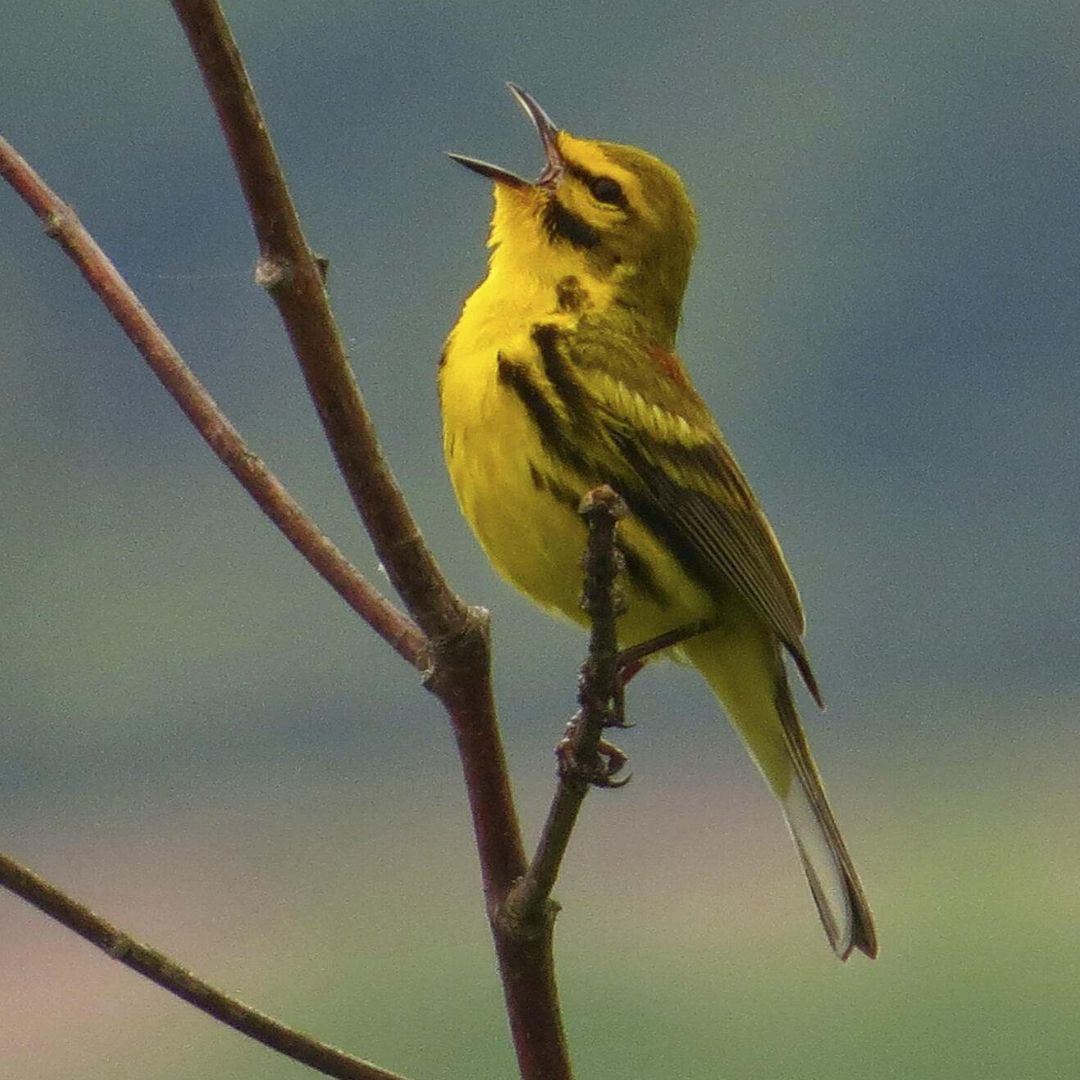
The openness of the barrens provides an ideal habitat for the prairie warbler, identifiable by their yellow feathers and the black semi-circles under their eyes. The prairie warbler song is often confused with the field sparrow’s. However, the field sparrow’s song is monotone like a bouncing ball, whereas the prairie warbler song goes up in pitch.
Log the Birds You See & Hear:
Use Our eBird Hotspotto upload the details of the birds you observe and hear at this station.


Hear the golden-crowned kinglet and explore the sights and sounds of Station 10.
True to its name, the golden-crowned kinglet can be best identified by a small golden spot on the top of its head. This small songbird makes its home in conifer trees. Look towards the top of the pitch pines surrounding you. If you see a small, cuplike nest towards their apex, it’s likely the home of a golden-crowned kinglet. These nimble little birds spend most of their time scavenging in bushes and tall grasses, looking for bugs. They will eat all kinds of bugs, bug eggs, and spiders (caterpillars are their favorite, though).
The area before you was last burned in August of 2025. TNC staff conduct vegetation monitoring in these burn units to catalogue changes in species composition pre and post burn. In 2011, Wendy Leuenberger conducted moth surveys and found that burned areas hosted significantly more species of globally rare moths than the unburned areas. As part of our adoptive management, TNC is consistently collecting similar data for plants, with one goal in mind: biodiversity.
That’s where you come in. By utilizing Merlin Bird ID and eBird, you can help us catalogue how biodiverse our feathered friends are here at the Long Pond Barrens. Help us to better understand the relationship between prescribed fire and avian habitat. Please upload an eBird checklist.
Hear the Eastern towhee and explore the sights and sounds of station 10.
This area was burned as recently as 2024, making the new growth of the forest edge an ideal foraging spot for the Eastern Towhee. You are more likely to see them hopping around on two feet as they scour the leaflitter scratching for food. They are rummaging for acorns, berries, and insects to help fuel them during their short migration.
The Eastern Towhee will appreciate this early successional edgeline. Younger scrub oak, like what you see along this edge, is dense enough to provide coverage. Birders all over will agree that the Towhee’s call sounds like they’re saying “Drink your tea.”
Log the Birds You See & Hear:
Use Our eBird Hotspotto upload the details of the birds you observe and hear at this station.


Get monthly emails with conservation news and updates on local projects.
Discover our efforts to conserve the lands and waters of the Keystone State, and explore the best places to immerse yourself in nature.


