
interstitialRedirectModalTitle

interstitialRedirectModalMessage

Places We Protect

Ruth C. Warwick Preserve

New Hampshire

A purple trillium flower with a blurred green background.
Warwick Purple Trillium Purple Trillium at the Warwick Preserve in Westmoreland, New Hampshire © Eric Aldrich/The Nature Conservancy

Discover Butterfield Hill’s rugged ridges, spring wildflowers and scenic forest trails.

Overview

Description

Ruth C. Warwick Preserve, located on Butterfield Hill in Westmoreland, is a rugged 40-acre sanctuary and a landmark in conservation history: it was the first property ever donated to The Nature Conservancy in New Hampshire. Protected in 1964, this preserve rises from 480 feet to 900 feet and features dramatic rocky outcrops overlooking Partridge Brook and the Connecticut River.

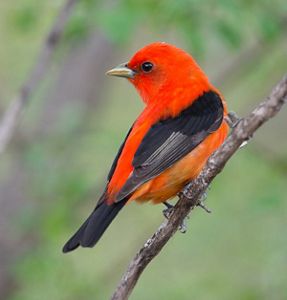
What makes this place truly special is its limestone-rich soils, a rarity in New Hampshire’s typically acidic landscape. These alkaline conditions create a unique environment where uncommon plants thrive—species like broad beech fern, showy orchis, Dutchman’s breeches, spotted wintergreen, and long-spurred violet. In spring and early summer, the forest floor bursts with wildflowers, while neo-tropical migrant birds such as warblers, thrushes, and scarlet tanagers fill the canopy with song. This combination of geology, flora, and fauna makes Warwick Preserve a haven for biodiversity and a fascinating destination for nature lovers.

Access

OPEN TO THE PUBLIC

Spring/early summer for wildflowers and birds. Winter/early spring can be icy.

Hours

Dawn to dusk daily.

Highlights

Limestone-rich soils allow uncommon plants like Dutchman's breeches and spotted wintergreen to thrive here, while neo-tropical birds fill the canopy in spring.

Size

104 acres

Explore our work in New Hampshire

Photos from Ruth C. Warwick Preserve

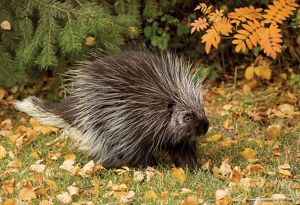
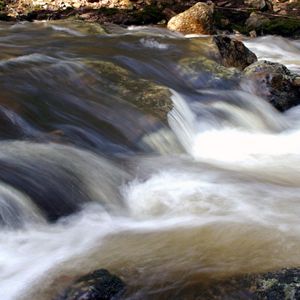
The preserve's rugged terrain includes the rushing waters of Partridge Brook and a mixed forest of hemlock, sugar maple, red oak, and basswood. Forty-foot high rocky outcrops provide views of the river while large boulders litter the forest floor below the rocky ridges creating habitat for snakes, porcupines and bobcats.

Four small white and yellow flowers.
A red and black bird standing on a branch.
A porcupine in the woods.
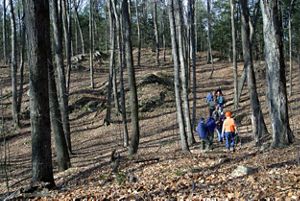
A group of people hiking in the woods in fall.
A pair of bobcats snuggled together in the snow.

Visit

    • Scenic Views: Climb to rocky ledges for river vistas and wooded ridges.
    • Wildlife: Spot snakes, porcupines, bobcats, and deer amidst forest and boulder fields.
    • Birdwatching: Listen for warblers, thrushes, rose-breasted grosbeaks, and scarlet tanagers.
    • Spring Flora: Discover showy orchids, Dutchman’s breeches, broad beech fern, maidenhair spleenwort, spotted wintergreen, and more.
  • Total Mileage: ~1.5 miles.
    Main Routes: Partridge Brook Trail climbs gently from a small parking pull-off. It leads to the steeper Cave Loop and May–December Trail.
    Terrain: Steep first one-third mile (480 ft → 900 ft), then levels out to scenic ledges.
    Trail Conditions: Some rough footing, stream crossings, and icy spots in early spring.

    • Trailhead & Parking: Limited to 3–4 cars in a pull-off by a white-railed bridge off NH-63.
    • Hours: Open dawn to dusk, year-round.
    • Difficulty: Moderate to strenuous—expect rocky terrain and significant elevation gain. Appropriate footwear and water recommended.
    • Best Seasons: Spring–early summer for wildflowers and birds. Winter or spring can be icy; use caution.
    • Pets: Dogs are not allowed at this preserve.
  • To minimize disturbance of the wildlife and habitat of this nature preserve and to support the enjoyment of all visitors, please follow these guidelines:

    • Foot traffic only.
    • Leave No Trace—please keep the preserve clean by carrying out your trash.
    • Respect the natural world around you! Do not remove or destroy plants, wildlife, minerals, rocks or cultural items.
    • No camping or open fires allowed.
    • Hunting is prohibited on the southern portion of the preserve (the Warwick tract), but allowed in other parts of the preserve. Please obey all posted signs and contact the New Hampshire Fish & Game Department for dates and regulations.
    • Pets are not allowed at this preserve.
    • Other Power-Driven Mobility Devices (e.g., utility vehicles, Segways, golf carts, etc.) are prohibited at this preserve. 
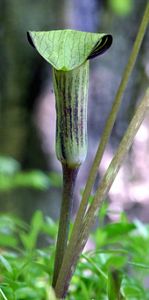
A tall, green pitcher plant.
Pitcher Plant Uncommon plants like this pitcher plant can be found at the Ruth C. Warwick Preserve. © Eric Aldrich/TNC

History

A Gift of Land and Legacy

The Ruth C. Warwick Preserve is rooted in a remarkable family story. In 1964, Dr. Ruth Warwick and her daughter Louise Hunninen donated 36 acres on Butterfield Hill to The Nature Conservancy, making it the first property ever donated to TNC in New Hampshire. Their gift ensured that this beautifully wooded hillside would remain intact for future generations.

Ruth’s connection to the land began decades earlier. After graduating from Boston University in 1904, she and her first husband, Dr. Coles, operated a tuberculosis sanitarium in West Keene. When Dr. Coles died during the 1917 flu epidemic, Ruth later married George Warwick in 1923, and the couple moved to Westmoreland. After witnessing an extensive clear-cutting operation on Butterfield Hill near their home, Ruth urged George to purchase a 36-acre parcel to protect its forest. She even asked a local handyman to clear out a spring on the hillside to provide water for wildlife—a feature still visible today near the steep section of the hiking trail.

The family spent years hiking and enjoying the property, but life brought changes. George passed away in 1933, and Ruth returned to Boston in 1938 to establish a medical practice to support herself and Louise. Though they lived away, they kept their Westmoreland home as a summer retreat for the next 20 years. The land remained so important to them that they permanently protected it by donating it to The Nature Conservancy in 1964. When Ruth died in 1973, Louise scattered her mother’s ashes on the preserve—a poignant tribute to her love of the land. Today, Ruth’s grandchildren still visit the property, keeping the family’s connection alive.

In 1998, the preserve grew when Ann Fisher donated an additional 68 acres, bringing its total size to 104 acres. Thanks to these acts of generosity, Warwick Preserve remains one of New Hampshire’s oldest TNC reserves—a quiet, rugged place where history and nature are deeply intertwined.

Nearby Preserves

Need more nature? Visit The Nature Conservancy's other preserves.

Find More Places We Protect

The Nature Conservancy owns nearly 1,500 preserves covering more than 2.5 million acres across all 50 states. These lands protect wildlife and natural systems, serve as living laboratories for innovative science and connect people to the natural world.

See the Complete Map

Support Our Work

Your contributions help us continue our conservation work in New Hampshire.