

interstitialRedirectModalTitle

interstitialRedirectModalMessage

Our Insights

Five Ways Conservation Keeps Wildlife Moving

By protecting animal migrations and movement, we can build a healthier, more resilient planet.

A flock of snow geese in flight.
Snow Geese in Flight A flock of snow geese takes flight after being spooked by a large bald eagle during their winter migration. © John Devlin/TNC Photo Contest 2022

Nature is always on the move—from regular roaming to seasonal migrations to the slower shifts driven by a changing climate. And that movement makes life possible. It spreads nutrients, keeps ecosystems in balance and supports economies and cultures along the way. Motion also depends on healthy, connected habitats—and today those connections are under threat like never before. That reality shapes how we think about conservation: not as a tool to freeze nature in place, but as a means to keep life in motion.


1. Connected Corridors Create Safe Journeys

Bobcats Without Borders To survive, bobcats need room to roam. © Jeff Wendorff

Just as we rely on sidewalks, bike paths and highways to move safely, many species need connected routes to cross over busy roads, through private lands and around developed areas. While the famously densely populated state of New Jersey is well connected for cars and people, routes for wildlife movement are disappearing—including in the Appalachian Mountains along the state’s northwest border.

Video: Building Bobcat Alley

Watch: Join us for a walking tour of Bobcat Alley

Building Bobcat Alley (2:58) Bobcats are New Jersey's last remaining wild cats. Once nearly extinct in our state, they are still endangered here. But they are trying to make a comeback, and to survive they need land to roam.

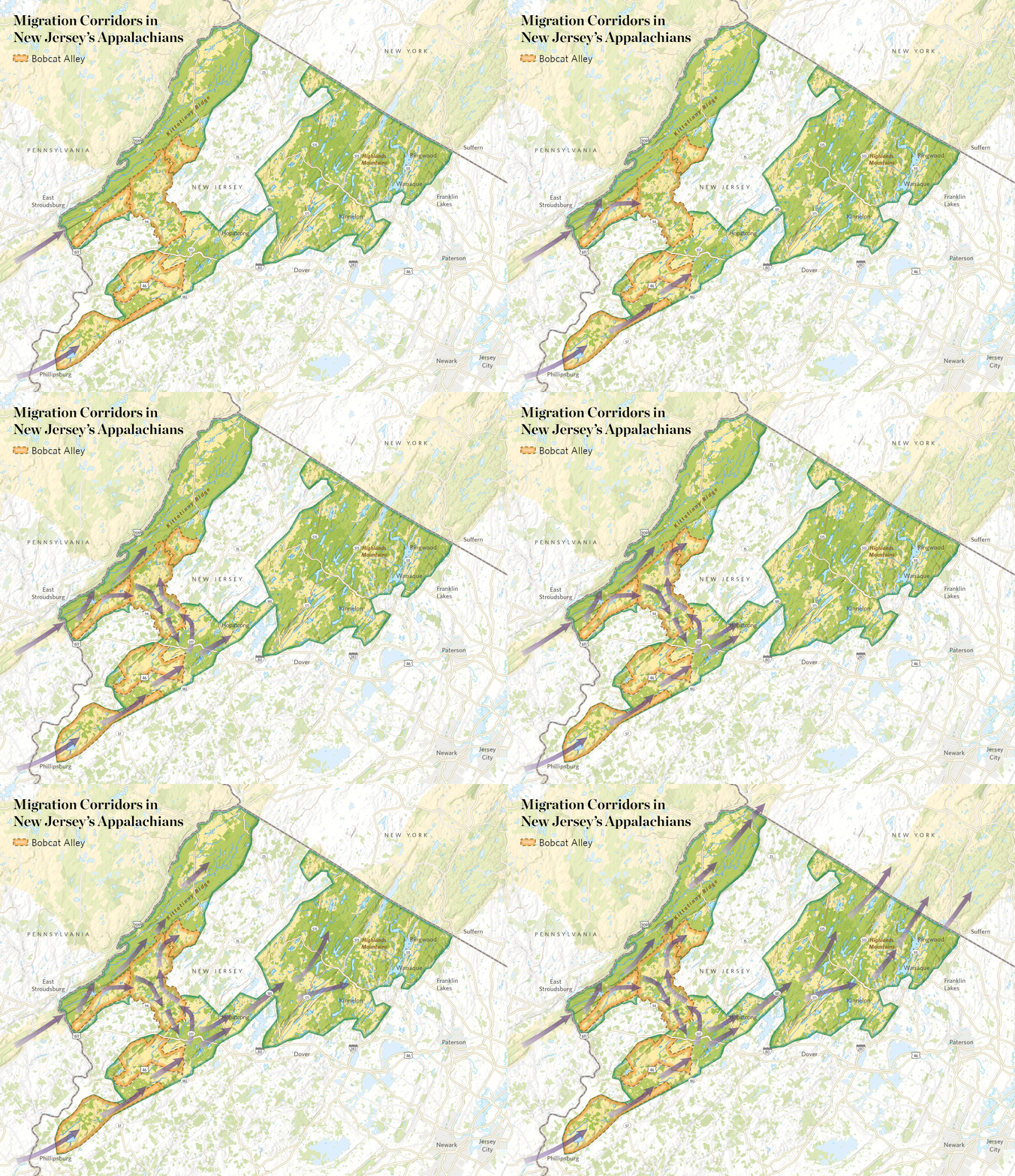
Here, the charismatic bobcat prowls ridgelines across a mosaic of lands known as Bobcat Alley, navigating safely through its conserved areas but facing danger where gaps persist. For more than a decade TNC has acquired and conserved connective lands within this 96,000-acre New Jersey greenway, which also links to preserved natural areas in New York and Pennsylvania. Combined, these lands create a 230,000-acre protected corridor that keeps migration routes between the central and northern Appalachian Range open and accessible. Building on this effort, TNC wrote, advocated for and effectively passed New Jersey’s first ever Wildlife Corridor Action plan in 2025, which mandates state agencies to consider habitat cores and crossings in their projects.

Migratory Flow in Bobcat Alley Migration corridors in New Jersey's Appalachians © TNC

And corridor conservation isn’t just good for bobcats—it’s essential for all wildlife moving across this part of eastern North America as the climate changes. Research shows that plants and animals are shifting their ranges an average of 11 miles northward and 36 feet upslope each decade in response to climate change, making Bobcat Alley a critical link in a continental migratory superhighway.

2. Smart Energy Planning Helps Wildlife Soar

Great Bustard (Otis tarda) An unmistakable, regal bird of treeless open plains and natural steppes. © Ramon Navarro / NiS / Minden Pictures

Renewable energy is essential for our climate future, but poorly planned infrastructure can fragment habitats—posing another threat to wildlife connectivity and migratory species. This challenge is increasingly visible across Europe, the first continent to pledge climate neutrality by 2050, and the story of renewable energy development across Portugal shows what’s at stake. Along with Spain, the country is home to 60% of the world’s remaining great bustard population, a striking bird that relies on open steppe landscapes to forage, mate and nest. Without smart siting, new renewable infrastructure could further disrupt the dwindling habitat this iconic species needs to survive in one of its last strongholds on Earth.

Video: Portugal's Renewable Future

Watch: Portugal's bold commitment to clean energy

Portugal's Renewable Future (1:27) Balancing renewable energy, nature conservation, and community priorities has become a real and achievable path forward for Portugal.

TNC research shows Europe has plenty of land to meet renewable energy targets without harming nature or communities, and a recent TNC study in Portugal has reflected the same trend. The analysis combined habitat data for 85 wildlife species—including endangered birds like the great bustard, raptors and bat colonies—with social values, community preferences and grid connection viability. It found that Portugal has more than five times the low-conflict lands needed to meet its 2030 goals for solar energy and 3/4 of its onshore wind can be built on low-conflict sites.

By identifying and mapping these smart siting zones across Europe, India and the U.S., TNC is helping companies build renewable energy in places that keep lands connected and skies open—a win for climate, people and wildlife movement.

Illustration of two cranes in flight with stylized graphics marking their flight path. In the background, the sun sets behind a mountain.
The Greatest Show on Earth Across the sky, over land, through rivers and across oceans, animals are constantly on the move. © Mikhaila Markham/TNC

Animals on the Move

How do we figure out where conservation is needed most? We get high-tech and track. Learn more.

3. Vast Ranges Give Wildlife Room to Roam

Candid Camera A wildlife camera captures an image of a snow leopard in Mongolia. © Sascha Fonseca

Not all species migrate, but many require enormous space. The endangered snow leopard is one of them, ranging across as many as 400 square miles (1,000 square kilometers). By hunting herbivores throughout this vast terrain, the snow leopard prevents overgrazing, which in turn sustains vegetation and stabilizes soils in Mongolia’s high-altitude habitats. Down on the steppe, nomadic herding communities depend on those same healthy grasslands for their livelihoods and cultural way of life.

Video: Mongolia's Snow Leopards

Watch: Rare snow leopard camera trap footage

Snow Leopard Research Up Close (1:16) This rare camera trap footage, captured under a rocky boulder formation in Mongolia, shows a snow leopard emerging from the open mountains and investigating the camera. These moments help conservationists understand snow leopard behavior and protect critical habitats.

To protect these interconnected systems as well as the wildlife and cultures depending on them, the Government of Mongolia, TNC and partners launched an ambitious plan to conserve 30% of Mongolia’s entire land area by the end of the decade. Achieving conservation at this scale requires government leadership, complex land use planning, committed community stewardship and strong partnerships to fund and sustain the effort. This is a proven model that TNC is helping advance on the ground and alongside national governments through a global initiative known as Enduring Earth. The effort in Mongolia shows that conservation can happen at the scale needed for the planet's mobile wildlife.

Where Snow Leopards Still Roam Advances in science and fieldwork have helped scientists and conservationists gain a better understanding of snow leopards, but there’s still much to learn—and better information is necessary to protect this species. © Chris Bruce/TNC

Sign up for Nature News:


Stay connected to nature with conservation stories, local opportunities & more.

4. Reconnected Rivers Connect Cultures, Too 

Fish Migration In spring, herring migrate up the Nemasket River in Middleboro, Massachusetts. © Eric Aldrich / TNC

Animal migrations have long been entwined with humanity’s culture, whether on the grasslands of Mongolia or along the rivers where fish undertake staggering endurance feats every year. Amazon’s dorado catfish might just win the migration medal, with its 6,500-mile round trip from the Atlantic Ocean to its spawning grounds in the rainforest’s high-mountain headwaters, and back again. These migratory species are central to Amazonian ecology, nurturing soils and sustaining Indigenous Peoples and Local Communities along their journey. Across the rivers of the northeastern U.S., river herring make similarly epic journeys that have sustained communities and inspired traditions for millennia.

Video: An Epic Journey

Watch: The great migration of the dorado catfish in the Amazon

An Epic Journey (4:00) One fish, the Dorado catfish, connects the rivers and people of the Amazon basin as it journeys on the longest freshwater migration in the world. It will only survive if we protect the interconnectedness of the great forest's free-flowing rivers.

Yet many North American rivers have been dammed for hydropower and diverted for farming; and the free-flowing Amazonian rivers that the dorado catfish depend on face these threats, too. TNC and partners are showing a path forward, working with utility companies and community partners to advocate for the removal of obsolete barriers and the installation of fish passages to reconnect flows.

And it’s working.

After years of runs numbering less than 2,000 fish, almost six million herring were counted in Maine’s Penobscot watershed during last year’s spring migration—the result of dam removals and passage improvements on the river’s main stem. And in the Amazon, cutting-edge science is helping conservationists learn more about the catfish’s lifecycle, migration routes and habitat needs to guide hydropower planning before disruption begins.

5. Well-Managed Food Systems Keep Animal Migrations in Balance

Migratory fish also feed the world, but weak oversight threatens their future. Take tuna: one of Earth’s most-fished and least-monitored commodities. These powerful swimmers travel thousands of miles across international waters every year, crossing jurisdictions with different fishing laws and enforcement mechanisms along the way. Tuna’s high commercial value combined with lack of monitoring on fishing vessels leads to illegal, unreported and unregulated fishing, and their wide-ranging journeys require international cooperation to manage and protect.

By advancing modern technologies like electronic monitoring on fishing vessels, TNC is helping to bring transparency back into the supply chain, while protecting tuna and other vulnerable species like sharks, seabirds and sea turtles that are often accidentally caught in and threatened by unmonitored fishing operations. At the same time, TNC launched the Tuna Transparency Pledge to encourage buyers and suppliers to source their tuna products from 100% monitored vessels. Better oversight helps sustain ocean ecosystems and the communities that depend on them, and this global call to action aims to drive industry-wide demand for better fishing practices and greater transparency at sea.

A school of tuna swimming in open water.
Bluefin Tuna Their wide-ranging journeys require international cooperation to manage and protect. © Brian Skerry
Map showing the migration path of tuna from spawning grounds in the Sea of Japan to the coast of California in the US.
Swimming the Distance From the spawning grounds in the Sea of Japan where they are born, young tuna embark on a 5,000 mile (8,000 km) long journey across the Pacific Ocean to the California coast. © NOAA

Movement Makes Us

Whether for food security, livelihoods, cultural connection or climate resilience, migrations sustain and inspire. They bring life. And they challenge us to think bigger. By protecting animal migrations and movements for the connected phenomena they are, we can advance conservation efforts at the massive scale our planet needs. This kind of conservation takes cooperation, collective action and creative problem-solving—and brings us toward a future where we can all thrive.


Explore More Stories: Animal Migration in Motion