Policy

Climate and Nature Finance Policy 

A pair of hands planting a tree sapling.
Tanga waterfund agroforestry Tree planting in the East Usambara mountains in Tanzania. © Roshni Lodhia

Stronger Economies Start with Nature

The economy depends on nature. Our financial systems should too. Nature underpins economic growth, resilience and long-term prosperity. But the value of nature is often overlooked in the decisions that shape development, investment and public finance. Progress is being made, but creating lasting change will require nature to become part of mainstream economic and financial decision-making.

By the Numbers

  • Green money icon.

    50%+

    of the global GDP depends moderately or highly on nature.

  • Green plant icon.

    $7T

    is spent by governments to support nature- and climate-negative subsidies every year.

  • Green icon.

    $68B

    accounts for less than 0.2% of annual government spending going to biodiversity domestically.

Featured Analysis

Building stronger economies and scaling finance for nature requires better evidence, stronger policy frameworks and practical tools for decision-makers. Working with partners across finance, policy and conservation, TNC is developing the evidence, tools and policy pathways needed to better integrate nature into the systems that shape economic and financial decision-making. This suite of analysis spans global finance trends, fiscal policy, sovereign debt and resilience planning.

  • Cover image for Financing Nature 2026 Report.

    Financing Nature 2026: A Mid-Decade Update

    The Financing Nature 2026 report explores where momentum is building around biodiversity finance and what it will take to bring proven solutions to the scale needed for people, nature and economies to thrive. Read the report

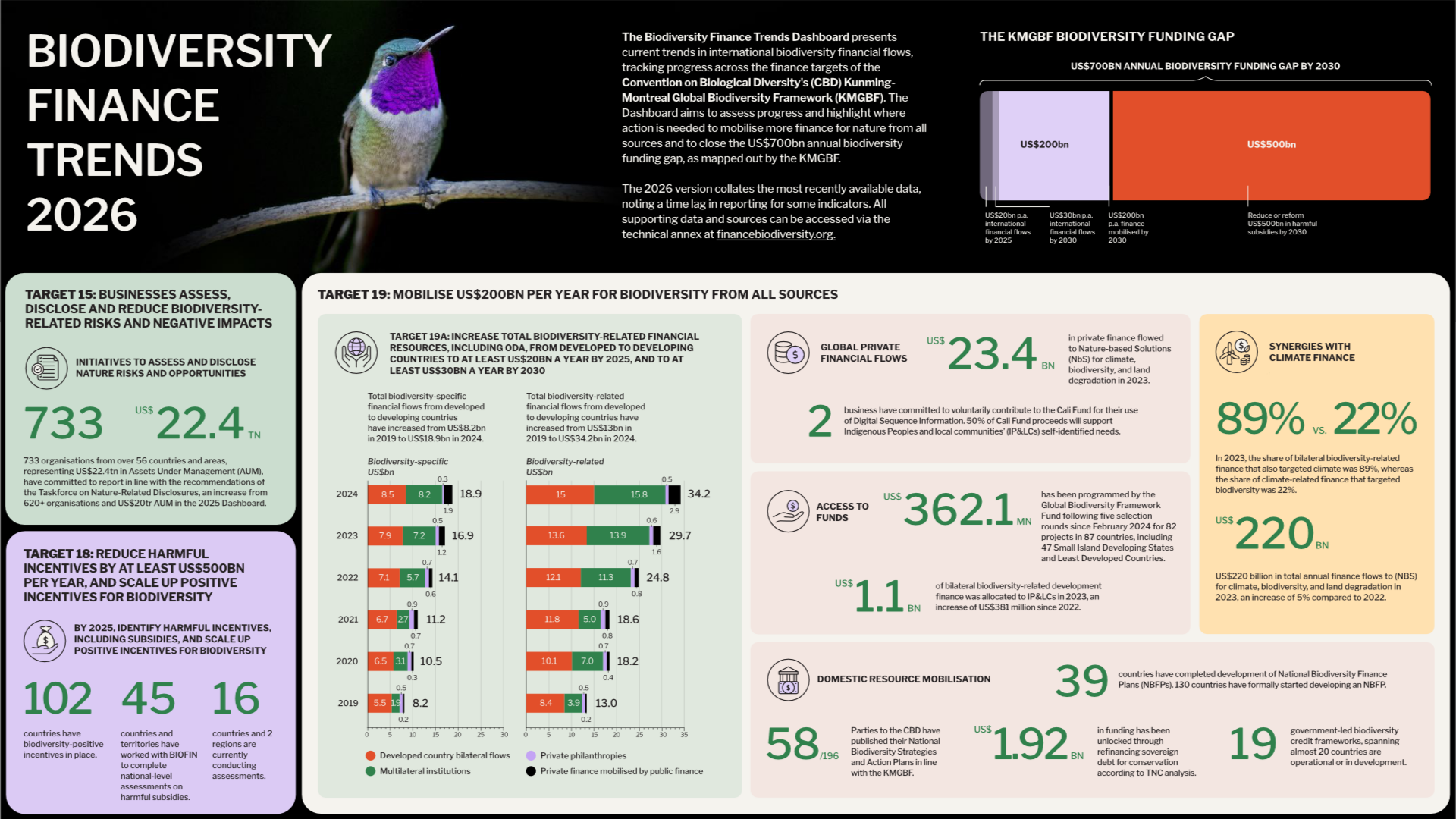
  • Biodiversity Finance Trends Dashboard 2026.

    Biodiversity Finance Dashboard

    Developed by the UK’s Department for Environment, Food and Rural Affairs (Defra), and TNC, this annual research tracks global trends in financing nature.  Explore the dashboard

  • Cover image for Incorporating Adaptation and Resilience into Macroeconomic Assessments policy brief.

    Incorporating Adaptation and Resilience into Macroeconomic Assessments

    This policy brief, developed by TNC and partners, outlines key recommendations for the IMF and World Bank’s Debt Sustainability Analysis. View the brief

Aerial view of river running through mountains.
Sunset over the Uur The Uur River winds its way through Khuvsgul Province. © B.Erdenebulgan

Shaping the Future of Economic Resilience

Nature is increasingly being recognized as a driver of economic resilience and long-term prosperity. TNC works to help translate that momentum into practical policies and financial approaches that strengthen economies while supporting nature.

  • Better Assess Risk: Helping decision-makers account for nature-related risks.
  • Align Incentives: Advancing policies and reforms that support resilient, nature-positive growth.
  • Invest for Long-Term Value: Unlocking investment approaches that recognize the value of nature.

TNC supports countries in creating credible, locally owned plans that mobilize public, private and domestic finance at scale and ensure nature is a core part of long‑term economic strategy.

Financial Solutions in Action

TNC also helps develop and advance innovative financial solutions that demonstrate how nature-positive finance can support economic resilience, sustainable development and conservation outcomes.

Nature Bonds

Debt conversion transactions that help countries reduce debt burdens while investing in conservation.

Enduring Earth

A partnership helping countries establish and finance large-scale conservation initiatives through Project Finance for Permanence.

Project Finance for Permanence

A proven model that secures long-term financing for conservation at scale.

NatureVest

TNC's impact investing and sustainable finance team, developing investment solutions that generate measurable benefits for people and nature.

Aerial view of canyon in Lake Powell.
Reflection Canyon Aerial 2 Reflection Canyon Aerial 2 // Lake Powell is the second largest man-made reservoir in the United States. It locates on the Colorado River in Utah and Arizona, United States. Plagued by climate change-fueled drought and increasing demand for water, it has fallen to its lowest level on record since it was first filled more than 50 years ago. When the lake level had dropped far enough that the exposed canyon walls created a pale © Jay Huang/TNC Photo Contest 2021

Investing In Nature

Explore more stories around how we're working with investors, lenders, and companies to identify the economic value of nature.

Financing Nature in and from Europe | TNC

Explore reports, case studies and insights from TNC's nature finance initiatives, projects and research in and from Europe.

Finance for nature is rising. Now it must scale.

New Biodiversity Finance Trends Dashboard data show progress, but domestic mobilization and finance reform continue to lag.

New Financing Nature 2026 Report Offers Playbook for Financing Nature Protection at Scale

Case studies provide playbook for projects that work

Government of Gabon Joins The Nature Conservancy and Enduring Earth to Mobilize US$200 Million for Transformative Community and Conservation Outcomes

The Gabon Infini Project Finance for Permanence unlocks blended funding across a 10-year timeframe, supporting the country’s ambitious sustainable development and biodiversity protection agenda .

From the Amazon to Antalya: COP31 can turn the TFFF from idea into inflection point

On the opening day of Climate Week NYC 2026, The Nature Conservancy hosted a celebration of progress to date on mobilizing the Tropical Forest Forever Facility.

Gaining Ground: State of Private Investment in Nature, 2026

A new TNC–Forest Trends report shows private investment in nature reached $60B, with fivefold annual growth from 2016–2025 and rising institutional momentum for future capital.

Nature’s Dividends: The Economic, Health and Safety Benefits of Investing in Nature

The Nature’s Dividends report finds that conservation is a cost-effective way to grow the U.S. economy, protect public safety and reduce healthcare costs.